



SEO for Wedding Planners: How to Get Booked Before the Confetti Even Settles
Here’s an uncomfortable truth about the wedding industry: your best client is a stranger who’s about to make one of the biggest purchasing decisions of her life, in a market she’s never shopped in before, on a deadline she can’t move. She doesn’t want ten options. She wants the right one, fast — and she’s going to find it on Google before she ever hears your name from a friend.
Most wedding planner websites are gorgeous. Beautiful photography, dreamy fonts, real weddings that make you tear up a little. What they usually aren’t is findable. This guide is about closing that gap — not by adding more sparkle to the site, but by fixing the unglamorous plumbing underneath it that decides whether Google shows it to anyone at all.
Why this niche plays by different rules
Most local businesses have repeat customers. A dentist sees the same family for twenty years. A wedding planner, by definition, never does — every client is a one-time buyer making a five-figure decision under a deadline that doesn’t budge. That changes the math. You’re not nurturing a long relationship over months of touchpoints; you’re winning a single, high-stakes moment of trust, usually compressed into a few weeks after the engagement.
Search demand also spikes in a way most industries never see: engagement season runs roughly November through February, and the search volume for “wedding planner near me” follows right behind it like a well-trained bridesmaid. If your site isn’t ready before that window opens, you’re not just missing traffic — you’re missing the one season when your entire year’s pipeline gets decided.
Win the Google Business Profile before anything else
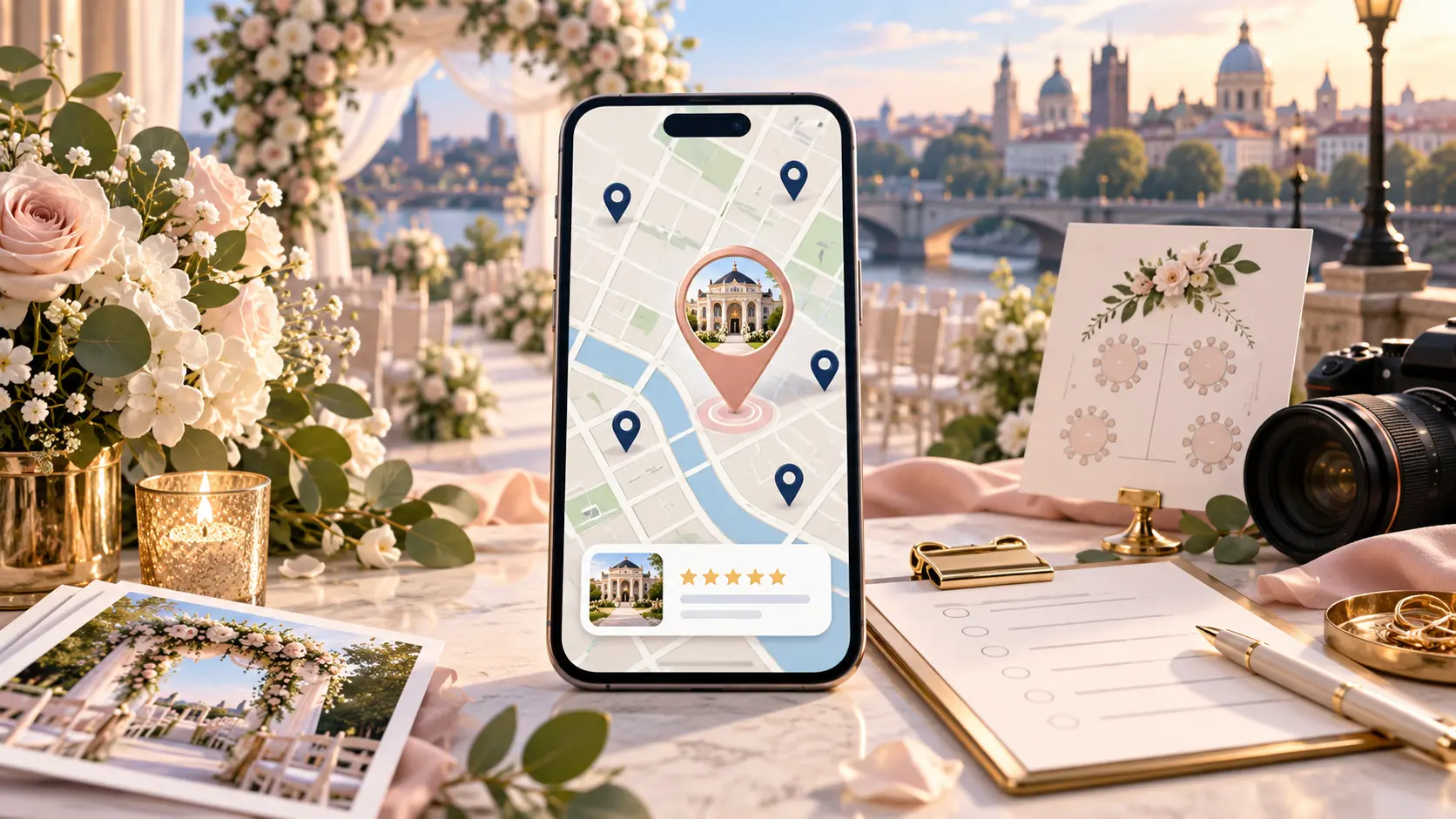
For “wedding planner in [city],” most couples never scroll past the map pack — so before you touch a blog post, get this right. Set your primary category to “Wedding Planner” specifically (use “Event Planner” only if that’s genuinely a bigger part of your business), fill in service areas, and upload real photos of your actual work — not stock images, and not just the finished tablescape, but setup, coordination in action, the moments that show a couple what hiring you actually looks like.
Reviews matter more here than almost any other local category, because trust is the entire product. Ask every couple within a week of the wedding, while the gratitude is still fresh — waiting three months gets you a much quieter response.
Structure your site around how couples actually search
“Wedding planner” alone is a crowded, generic term. The searches that actually convert are far more specific — and that specificity is your opportunity, not a limitation.
| Search intent | Best page | What to include |
|---|---|---|
| Local, general | Homepage / main service page | City, service area, core offering, clear next step |
| Style-specific (“boho wedding planner”) | Dedicated style page | Real examples in that style, not just a tag on a generic gallery |
| Destination (“Tuscany wedding planner”) | Destination page | Logistics knowledge, past events there, vendor relationships on the ground |
| Budget-conscious (“affordable wedding planner”) | Package or pricing-tier page | Honest ranges, what’s included at each tier |
| Research phase (“questions to ask a wedding planner”) | Blog / FAQ content | A genuinely useful answer, with a natural path to inquire |
A single generic gallery page can’t hold all of that weight. Each of these is a different buyer with a different worry, and each deserves a page built to answer that specific worry — not a slice of a portfolio page hoping the right couple scrolls far enough to find it.
The technical problem this industry rarely talks about
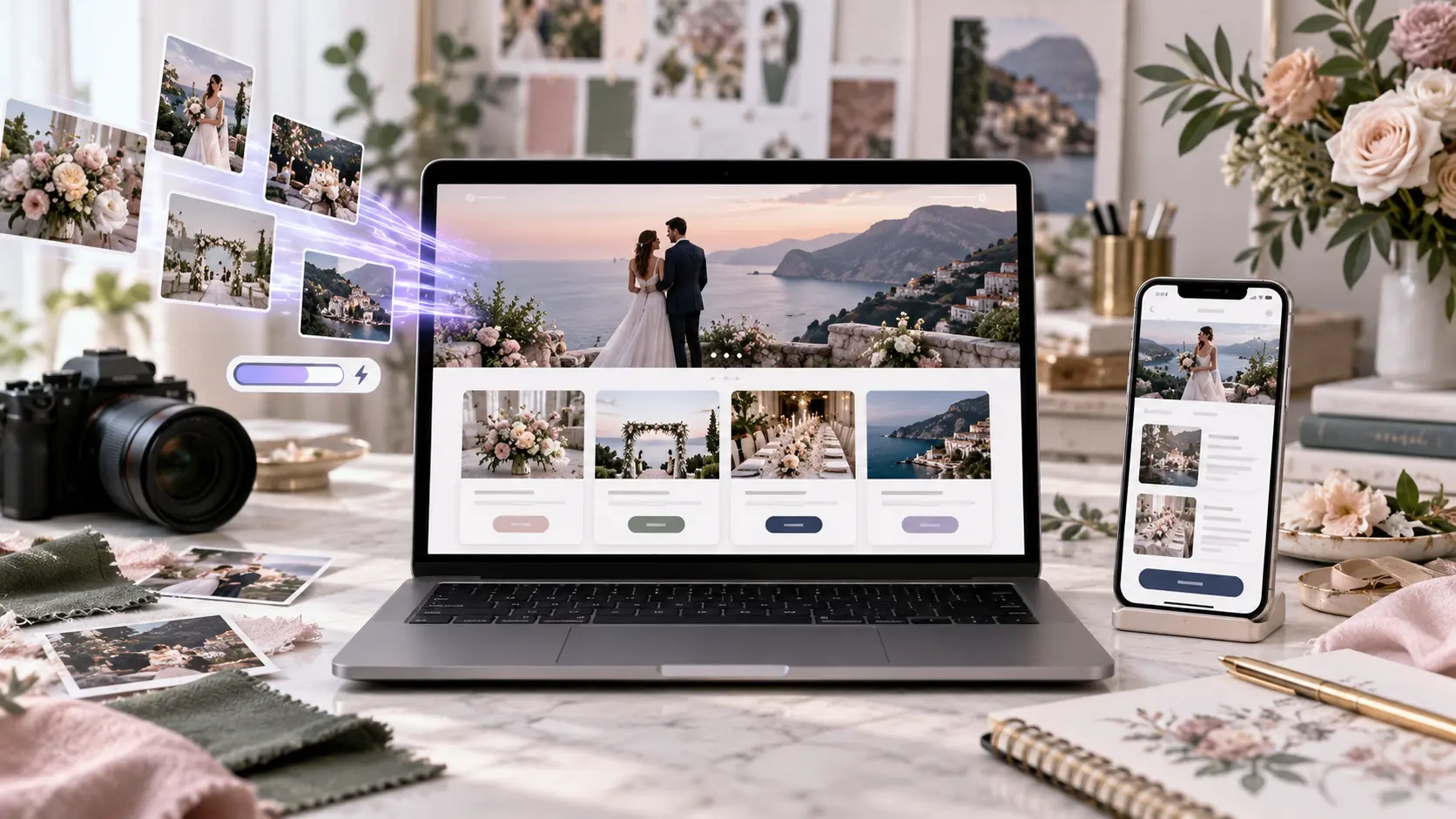
Wedding websites live and die by beautiful imagery, which means most of them are built on visually-driven platforms — Showit, Squarespace, heavily templated WordPress themes — optimized for gorgeous galleries, not for what a crawler can actually read. Two failure points show up constantly:
The second is page speed. A single real-wedding gallery can run 40+ high-resolution images, and on a mobile connection at a coffee shop, that’s the difference between a couple waiting for your site to load and clicking back to the next search result. Compress images, lazy-load anything below the fold, and don’t let the platform’s default settings serve full-resolution files to every visitor.
Content that builds trust before the first call
Couples researching a wedding planner aren’t just comparing portfolios — they’re trying to answer “can I trust this person with the biggest day of my life?” That’s a harder question than “do I like their aesthetic,” and it’s answered by content, not just photography: what a full-planning package actually includes versus month-of coordination, honest answers to the awkward questions (budget, backup plans for weather, what happens if a vendor cancels), and real-wedding features that read like a story, not a slideshow.
This is also where local knowledge becomes a genuine moat. A national wedding blog can write generically about “questions to ask your planner.” Only you can write “what actually happens if it rains at [specific local venue] in June” — and that kind of specificity is exactly what a couple searching that scenario is desperate to find.
Is your beautiful website actually being found?
Klucco can audit your site’s technical health, local visibility, and content structure, then turn the findings into a plan that fits how your clients actually search.
Backlinks the way this industry actually earns them
You won’t out-link The Knot or Style Me Pretty on domain size, and you don’t need to — you need links that carry local and industry relevance instead. Cross-promote with the photographers, florists, and venues you’ve actually worked with (a shared real wedding feature benefits everyone involved). Submit standout weddings to regional wedding blogs and style publications, which are always hungry for fresh real-wedding content with genuinely good photography behind it. A venue’s “recommended vendors” page is a small link with outsized relevance — it’s placed exactly where an engaged couple is already deciding who to call.
The AI search shift couples are already living in
Engaged couples increasingly ask ChatGPT or Perplexity “who’s a good wedding planner in [city]” the same way they’d ask a friend — and these tools pull their answers from the same trust signals that matter for traditional search: consistent information across the web, genuine reviews, and content that clearly and specifically answers a real question rather than skating past it in vague marketing language. Everything in this guide — a complete profile, honest content, real reviews — is also exactly what positions you to be the answer when a couple asks an AI assistant instead of Google.
Common Wedding Planner SEO Mistakes
- Building the entire portfolio in JavaScript with no readable text content around it.
- Uploading dozens of full-resolution images with no compression, tanking mobile load times.
- Targeting only “wedding planner” and ignoring the style, destination, and budget searches that actually convert.
- Setting the wrong primary category on the Google Business Profile.
- Waiting months after the wedding to ask for a review, when the gratitude has already faded.
- Writing generic “how to plan your wedding” content that could belong to any planner, anywhere.
Ready to book out next season before it even starts?
Tell Klucco about your business and your ideal client. We’ll show you exactly where your visibility is leaking.
