


SEO for Fitness Businesses: How Gyms, Studios, and Trainers Get Found Locally
A fitness business can have excellent coaches, modern equipment, loyal members, and still remain almost invisible beyond its immediate neighborhood. The problem is not always a lack of demand. Often, Google cannot confidently connect the business with a particular service, location, and type of customer — or the website does not give a potential member enough confidence to book a trial.
That is why fitness SEO is more than publishing workout articles. A person searching for a beginner Pilates class, a 24/7 strength gym, or a personal trainer after an injury expects a precise local answer. Your Google Business Profile has to establish relevance and location; your service pages have to match the need; and your website has to turn that visit into a call, booking, or trial session. This guide explains how those pieces work together and where a gym, boutique studio, or trainer should start.
Why fitness-business SEO plays by different rules
A “fitness business” isn’t one thing. A solo personal trainer, a 24/7 strength gym, a boutique Pilates studio, and a multi-location martial arts academy compete for different searches and convert customers in different ways. They do share two challenges: strong local competition and a trust-heavy buying decision. People want to know not only what is nearby, but also whether the training style, atmosphere, schedule, price, and coach suit them. SEO has to answer both questions: “Can I find this business?” and “Do I want to train there?”
The Google Business Profile factors that actually matter
The 2026 Local Search Ranking Factors report from Whitespark asked 47 local SEO professionals to score 187 potential factors. It is an expert survey rather than a disclosure of Google’s algorithm, but it provides a useful picture of what experienced practitioners repeatedly observe in local search.
| Ranking factor | Relative weight (survey score) |
|---|---|
| Primary GBP category | 227 |
| Proximity of address to the searcher | 225 |
| Keywords in the GBP business title | 223 |
| Physical address in the city being searched | 213 |
| Business shown as open at time of search | 189 |
| High numerical Google rating (4-5 stars) | 181 |
The primary category is therefore an important place to start, but “more specific” is only better when it accurately represents the main business. Choose the closest legitimate category, then add secondary categories for real additional services. Complete the services, real opening hours, phone number, website and booking link, attributes, description, and photographs. Check the map pin as well: a perfect profile attached to the wrong point on the map is still a bad local result.
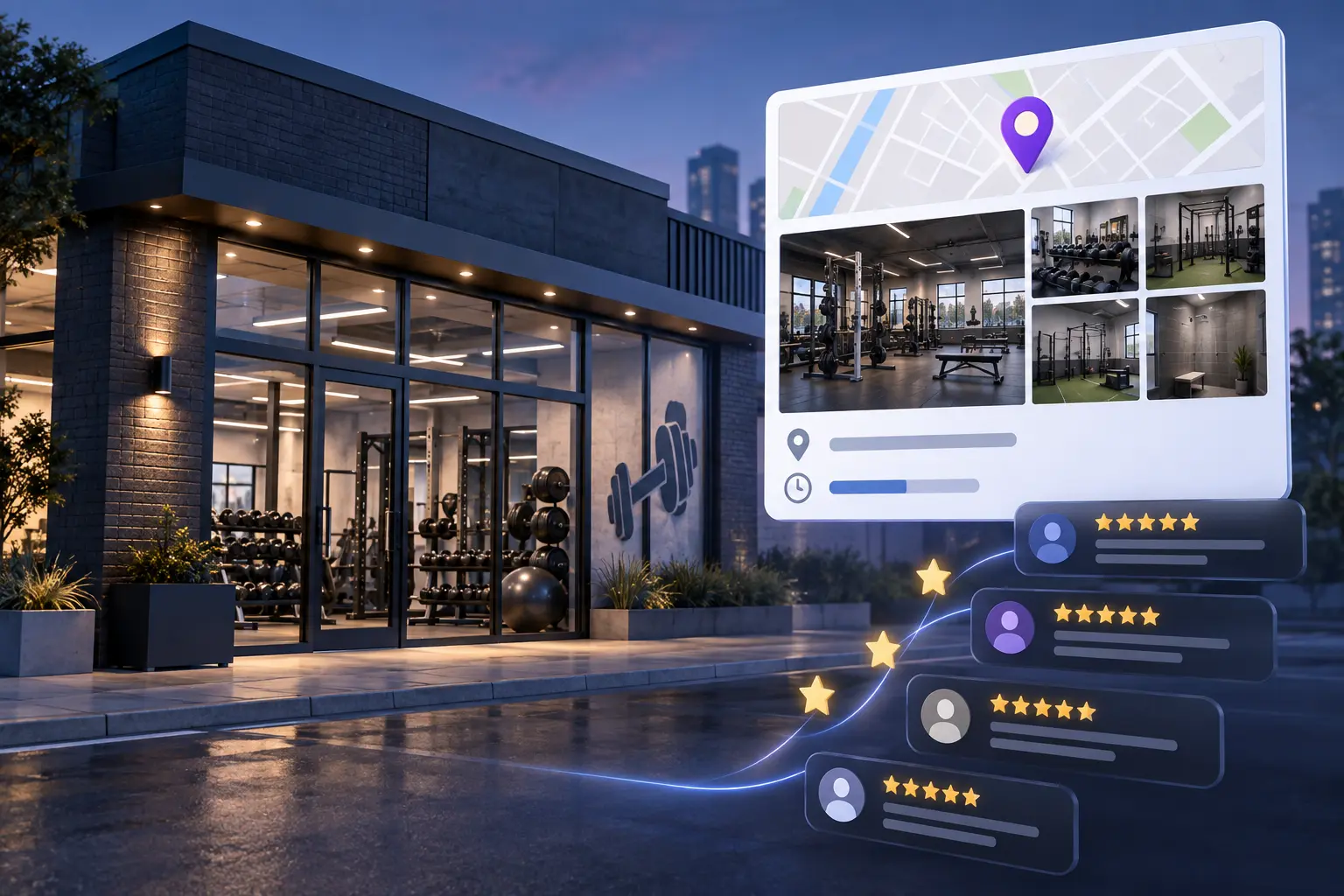
One result in the table needs context. Keywords in a business title correlate strongly with local visibility, but that is not permission to rename “Northside Fitness” as “Northside Best Gym Personal Trainer Berlin.” Use service or city terms only when they are part of the genuine real-world business name. Artificial additions can violate Google’s Business Profile guidelines and create suspension risk.
A practical Google Business Profile check
Start by looking at the profile as a new member would. Can someone immediately understand what kind of facility this is, where it is, whether it is open, and how to book? The essentials are straightforward:
- Use the most accurate primary category and only relevant secondary categories.
- Keep the name, address, phone number, hours, website, and map pin accurate.
- Add the programs and services people can genuinely book, together with a direct appointment or trial link.
- Use current photographs of the entrance, training areas, equipment, classes, and coaches rather than stock images.
- Review the profile regularly after timetable, holiday-hour, staff, or service changes.
This is not a one-time setup screen. It is a customer-facing branch of the business and should be maintained with the same care as the timetable on the website.
Recent reviews matter for visibility — and even more for trust
Reviews play two related but different roles. Whitespark’s expert survey places rating, review quantity, recency, and sustained review growth among important Local Pack signals. The BrightLocal Local Consumer Review Survey 2026 measures something else: how consumers evaluate businesses. Its panel of 1,002 US adults shows why rankings without a convincing reputation may still fail to produce members.
- 97% of consumers read reviews before choosing a local business, and 41% now “always” read them — up sharply from 29% the year before.
- 47% won’t use a business with fewer than 20 reviews. A handful of five-star reviews from your first month no longer clears the bar.
- 74% only care about reviews from the last three months. Recency now matters more than total count — a gym with 200 reviews and none in six months can lose to a newer competitor collecting them weekly.
- 31% will only use a business with 4.5+ stars, up from 17% a year earlier. Star-rating expectations are rising fast.
These are US consumer benchmarks, not universal thresholds and not direct measurements of Google’s algorithm. Still, the operational lesson travels well: ask for honest reviews continuously rather than in a one-time opening campaign. Request them after a meaningful milestone — a first month completed, a goal reached, or a positive conversation — and make the process easy with a direct link. Never offer a reward specifically for a positive review. Respond naturally to both praise and criticism so prospective members can see that real people are listening.
Program pages beat one generic “classes” page
The single most common structural mistake on fitness-business websites is a single “Classes” or “Programs” page trying to rank for everyone at once. A parent searching for kids’ martial arts, a beginner looking for their first CrossFit class, and someone specifically wanting 24/7 gym access without classes are not looking for the same thing — and one page cannot credibly answer all three searches.
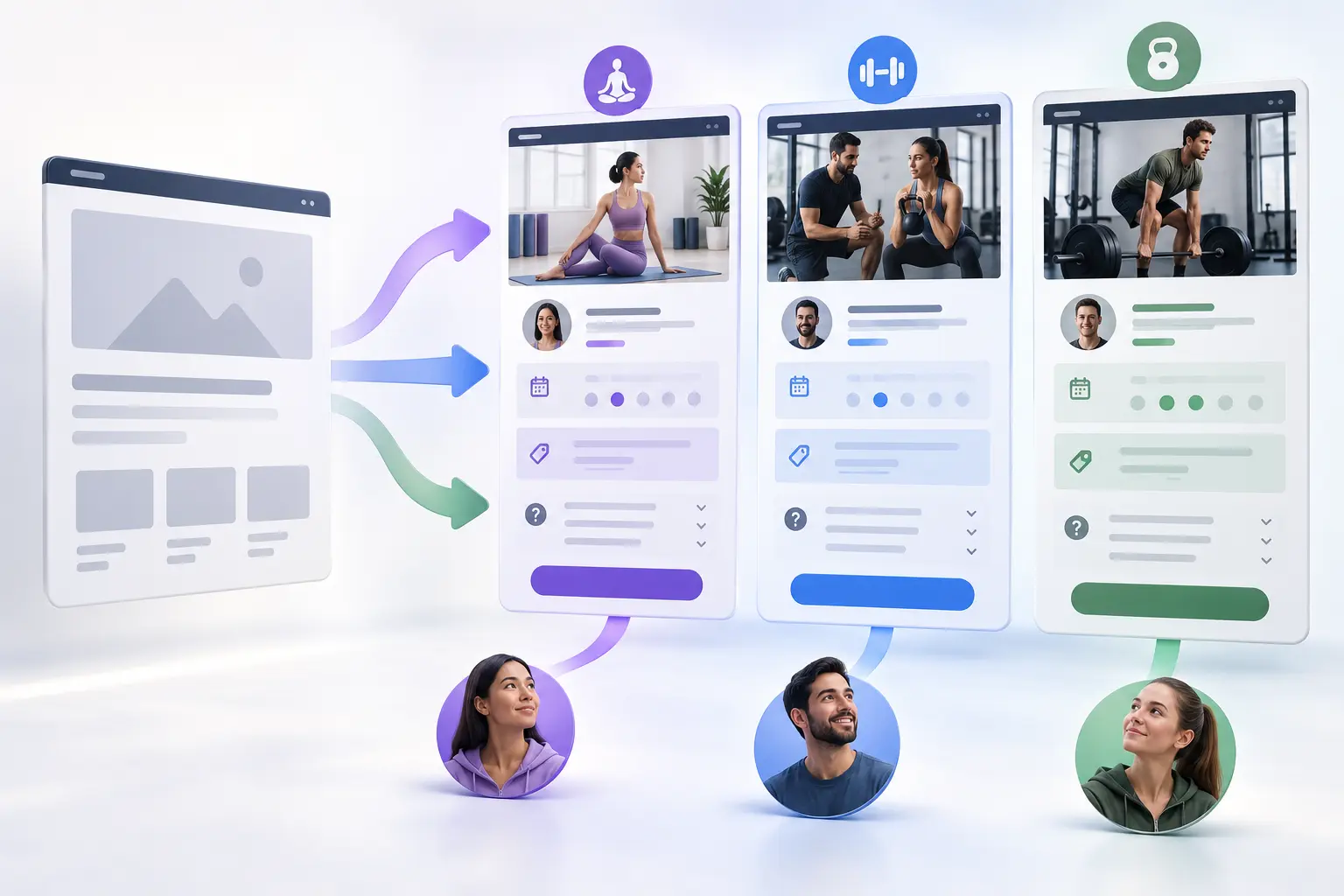
Build a dedicated page for every meaningful program or audience, but only when there is enough distinct information to justify it. The goal is not to generate dozens of near-empty keyword pages. It is to give a beginner, a parent, or an experienced athlete the answer designed for their situation.
What a useful program page should contain
A strong page begins with a clear promise such as “Beginner Pilates Classes in [City]” and immediately explains who the class is for. It should describe the training, expected level, schedule, coach, location, and what happens during the first visit. Price, membership terms, or at least the trial offer should not be hidden behind vague language.
Real class photographs and a short instructor profile reduce uncertainty. Relevant member feedback adds proof. A concise FAQ can answer questions about equipment, age, injuries, changing rooms, parking, or cancellations. The page should end — and preferably begin — with one clear action such as “Book a Trial Class,” not five competing buttons.
Location pages, for multi-location or service-area businesses
If you operate more than one physical location, a single “About us” page listing every branch gives both search engines and customers little branch-specific information. A dedicated page can show the address, timetable, available programs, coaches, transport, parking, photographs, reviews, and booking route for that facility. Large sets of thin pages that merely swap the city name may be treated as low-value or doorway-style content and fail to rank. Create a location page because the location offers a genuinely distinct customer experience, not because another city keyword can be inserted into a template.
Being recommended by AI search tools
BrightLocal’s 2026 survey found that reported use of ChatGPT and other generative AI tools for local recommendations rose from 6% to 45% in one year, making AI tools the third most-used recommendation source in that US panel. That does not mean 45% of all gym searches now happen in ChatGPT. It does mean that clear, consistent business information is becoming useful beyond the traditional Google results page.
Keep program names, locations, prices, instructor information, policies, and opening hours consistent across your website and important profiles. Answer real questions in plain language and build mentions on relevant local and industry sites. LocalBusiness schema can help machines interpret explicit facts, but it does not guarantee a recommendation or citation. AI visibility is earned through clear information and corroboration, not through schema alone.
How this differs by business type
Solo personal trainers are essentially a one-person local business — Google Business Profile and personal brand carry almost the entire weight, since there’s rarely a large enough site to build extensive program pages around. A trainer’s biggest lever is usually reviews plus a handful of genuinely useful pages (specialties, pricing, in-home vs. studio options).
Boutique studios (Pilates, yoga, small-group training) lean harder on community and visual trust signals — photos, class atmosphere, instructor bios — because the buying decision is as much about fit and vibe as about proximity.
Multi-location gyms and franchises need the location-page structure above to avoid every branch competing against every other branch for the same generic homepage.
Martial arts and youth-program academies often have two distinct audiences on the same site — adults and parents booking for kids — and benefit from separating that content clearly rather than blending it into one “classes” page.
Common mistakes fitness businesses make with SEO
- Setting a generic “Gym” category instead of the most specific one that applies.
- Treating reviews as a launch-week task instead of an ongoing habit.
- Running every program through one undifferentiated page.
- Publishing generic fitness content (“5 reasons to work out”) that doesn’t answer a specific, bookable question and doesn’t rank for anything a prospective client would search.
- Ignoring mobile experience, even though most local fitness searches happen on a phone in the minutes before someone decides where to go.
That said, the honest middle ground on blogging: generic motivational content rarely ranks, but content answering the actual questions prospects have before booking — pricing, what a first session looks like, whether a program suits beginners — both ranks and does real conversion work. The mistake is publishing filler, not publishing at all.
Turning local visibility into trial bookings
Ranking is only the first half of the job. A prospective member may arrive between meetings, on the train, or immediately after deciding that today is finally the day to start. If the mobile page makes them hunt for a timetable, price, address, or booking form, motivation disappears quickly.
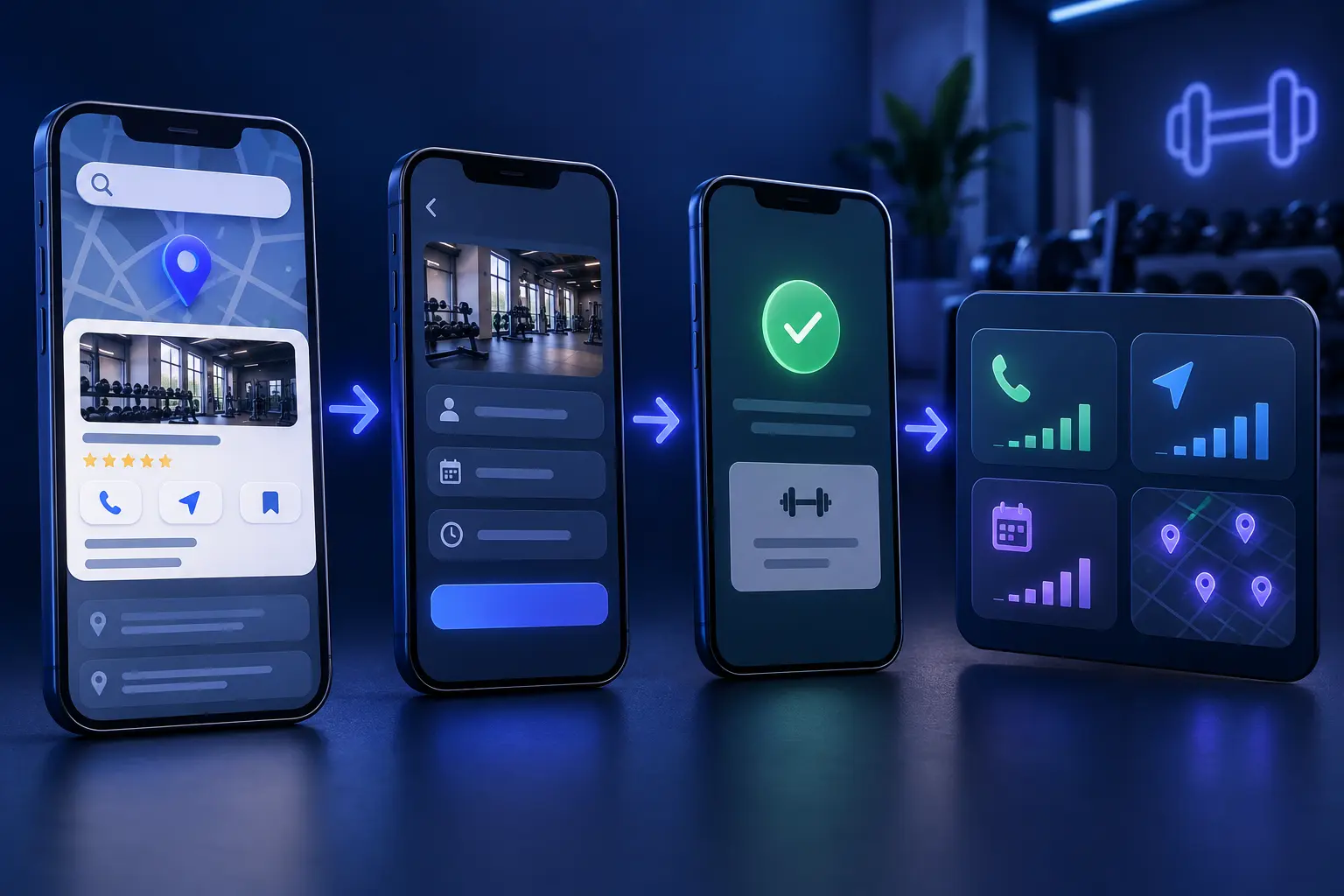
Put the primary action near the top of each program and location page. Show the schedule without forcing an account creation, explain the trial offer and membership conditions, and keep phone or message options visible. Real photographs of the facility and named coach profiles answer the trust questions stock images cannot. Practical details such as parking, public transport, changing rooms, accessibility, and what to bring may look minor, but they often determine whether a first-time visitor completes the booking.
The booking flow should be tested on a real phone. Count the taps from landing page to confirmed trial and remove unnecessary choices. The best SEO page is not the one with the most keywords; it is the one that gives the right visitor enough information and confidence to act.
How to measure whether fitness SEO is working
Do not judge the campaign by one headline keyword. Local results change by neighborhood, device, and time of day, and a ranking can improve without producing a single valuable enquiry. Start with a baseline, then connect visibility to business outcomes.
Google Business Profile interactions — website visits, calls, direction requests, and booking clicks — show whether the listing is generating action. Search Console reveals growth in non-branded local queries and which program pages are gaining impressions. GA4 or another analytics platform should record completed trial forms, calls, and booking confirmations, not only page views. For location-based rankings, a local grid tracker is more informative than checking once from the studio reception.
A simple monthly review should answer three questions: Are more relevant local people finding us? Are they reaching the correct program or location page? Are more of them booking? If visibility rises but trials do not, the next task may be pricing clarity, trust, mobile usability, or the booking process rather than another article.
Want your gym, studio, or training business actually found locally?
Klucco can audit your Google Business Profile, review strategy, and site structure, and build a plan around what’s actually holding your rankings back.
How long it takes and what it costs
Profile corrections can be implemented quickly, but there is no fixed number of weeks in which Google must change a Local Pack position. New program and location pages may begin gaining impressions within a few months for less competitive queries, while dense metropolitan markets can take substantially longer. Treat these as planning ranges, not guarantees.
Pricing also varies by market and scope. An Ahrefs survey of 439 SEO providers, updated in 2024, estimated average local SEO pricing at $1,557 per month. That is a provider-side benchmark, largely useful for understanding the US and international market; it is not a minimum price every single-location studio must pay. A smaller budget can fund focused consulting or a limited set of priorities, while a multi-location business needing content, technical work, listings, reputation support, and reporting will require a broader scope.
Frequently Asked Questions
Ready to get your fitness business found by the right local clients?
Talk to Klucco about your specific market, competitors, and goals — a plan built around your business, not a generic template.
