



PPC Landing Pages: How to Turn Paid Clicks Into Customers
Your ad did its job. A potential customer searched, noticed your message, and clicked. Then your homepage greeted them with six menu items, three unrelated services, a company timeline, and a heroic photograph of the office coffee machine.
The customer left. Google still charged you.
A PPC landing page is the bridge between paid traffic and a measurable business result. It should continue the promise made in the ad, answer the visitor’s immediate questions, remove unnecessary choices, and make the next step feel safe. This guide explains how to build that bridge for Google Ads and other pay-per-click campaigns—without turning the page into a carnival of buttons, pop-ups, and “BUY NOW” banners.
What Is a PPC Landing Page?
A PPC landing page is a focused page created for visitors arriving from a paid advertisement. Unlike a homepage, which introduces the whole business, a landing page for PPC serves one audience, one intent, and one primary conversion goal.
That conversion might be:
- requesting a quote;
- booking a consultation;
- calling a local business;
- starting a trial;
- buying a product;
- downloading a useful resource.
The page does not need to be short. It needs to be focused. A €25 purchase may require a few persuasive sections; a €25,000 B2B contract may need proof, technical detail, an implementation outline, and answers to procurement concerns. “One page, one goal” does not mean “one screen, no information.”
Why Sending PPC Traffic to Your Homepage Usually Fails
A homepage must speak to several audiences at once. It explains the company, presents multiple products, supports existing customers, attracts candidates, and helps visitors navigate. That flexibility is useful for general traffic but often expensive for paid clicks.
Imagine someone searches for “emergency commercial electrician in Hamburg.” They do not want to explore your company philosophy. They want to know whether you serve Hamburg, handle commercial emergencies, can respond quickly, and can be contacted now.
A dedicated pay-per-click landing page answers those questions immediately. This matters because Google evaluates landing page experience as one component of Quality Score, alongside expected click-through rate and ad relevance. Google also makes an important distinction that many articles miss: Quality Score is a diagnostic tool, not a KPI and not a direct input into the ad auction. Use it to locate relevance problems, but judge the campaign by qualified leads, sales, cost per acquisition, and profit. See Google’s explanation of Quality Score.
If you are still deciding whether paid search makes financial sense, start with our Google Ads decision framework. A better landing page improves the economics; it cannot rescue an offer with no demand or no margin.
The PPC Conversion Chain: Where Landing Pages Fit
A conversion is not produced by one clever headline. It is the result of an aligned chain:
- Search or audience intent: What does the person actually need?
- Keyword and targeting: Did the campaign identify that need correctly?
- Ad promise: What outcome, offer, or advantage earned the click?
- Landing page: Does the page confirm and expand that promise?
- Conversion action: Is the next step clear, proportionate, and trustworthy?
- Follow-up: Does the business respond quickly and competently?
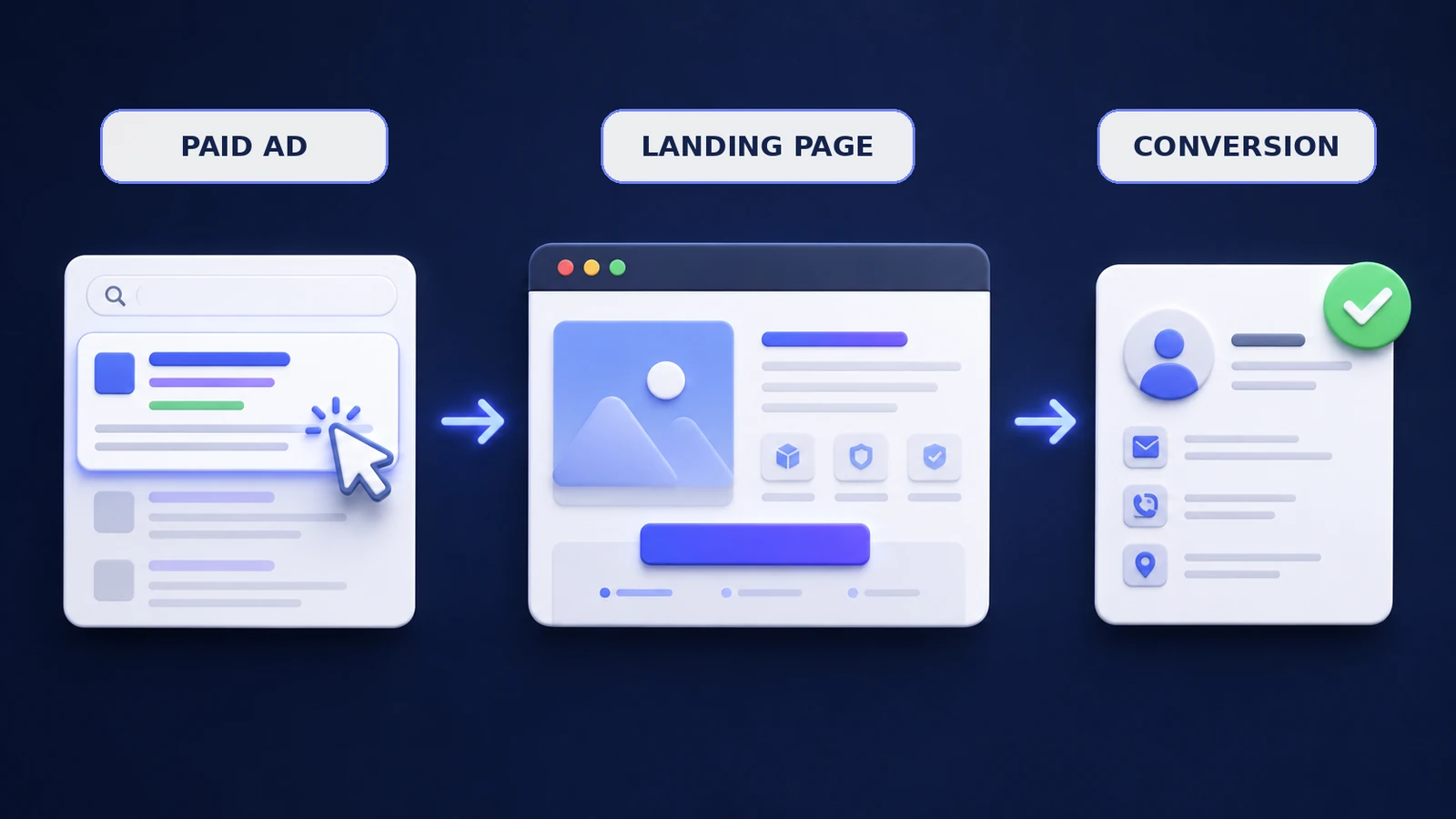
Optimizing only the page while ignoring irrelevant search terms is like polishing a shop window in the wrong neighborhood. Conversely, excellent targeting cannot compensate for a confusing page. Small businesses need the entire chain to work because they have less budget available for “learning through expensive mistakes.” Our guide to PPC for small businesses covers the broader campaign foundation.
Start With Intent, Not a PPC Landing Page Template
Templates are useful for layout. They are dangerous when they replace thinking. Before applying generic PPC landing page best practices or choosing a hero image and button color, define the visitor’s intent. The most useful landing page best practices begin with context, not decoration.
Separate Different Jobs the Visitor Is Trying to Complete
These searches may relate to the same business but deserve different experiences:
- “accounting software pricing” requires plans, costs, and commercial comparison;
- “accounting software for construction” requires industry-specific workflows and proof;
- “switch from spreadsheets to accounting software” requires education and risk reduction;
- “book accounting software demo” requires a fast scheduling path.
You do not necessarily need a unique page for every keyword. Create a separate page when the audience, offer, evidence, objection, or desired action changes materially. Closely related keywords with the same intent can share one strong page.
Write a One-Sentence Page Brief
Use this formula before building:
For [audience] arriving from [campaign/ad group], this page will prove [specific value] and encourage [one primary action].
Example: “For owners of German HVAC companies searching for Google Ads management, this page will show how Klucco reduces wasted local-search spend and encourage a strategy call.” If a section does not support that brief, remove it or move it elsewhere.
Message Match: Make the Click Feel Like the Right Decision
Message match means maintaining continuity between the keyword, advertisement, and page. Visitors should recognize the same problem, offer, terminology, and conditions after clicking.
If the ad promises “Free delivery on office chairs in Berlin,” the page should not open with “Furniture for a Better Tomorrow.” Beautiful? Perhaps. Reassuring? Not remotely.
Match the following elements:
- Intent: informational, comparative, local, or transactional;
- Offer: the same product, service, discount, trial, or consultation;
- Language: repeat the visitor’s natural terminology without stuffing keywords;
- Location: reflect the market or service area advertised;
- Conditions: keep price, eligibility, deadlines, and exclusions consistent;
- Visual context: avoid an ad about one product leading to a generic category image.
For dynamic or broad campaigns, check actual search terms regularly. An apparently strong page may be a poor match for the traffic Google is really sending.
Getting Clicks but Not Enough Customers?
A landing page cannot fix poor targeting—and great ads cannot rescue a weak landing page. See how Klucco connects campaign structure, conversion tracking, and landing page optimization.
A High-Converting PPC Landing Page Structure
There is no universal wireframe, but the following sequence works well for many B2B, local-service, SaaS, and considered-purchase campaigns.
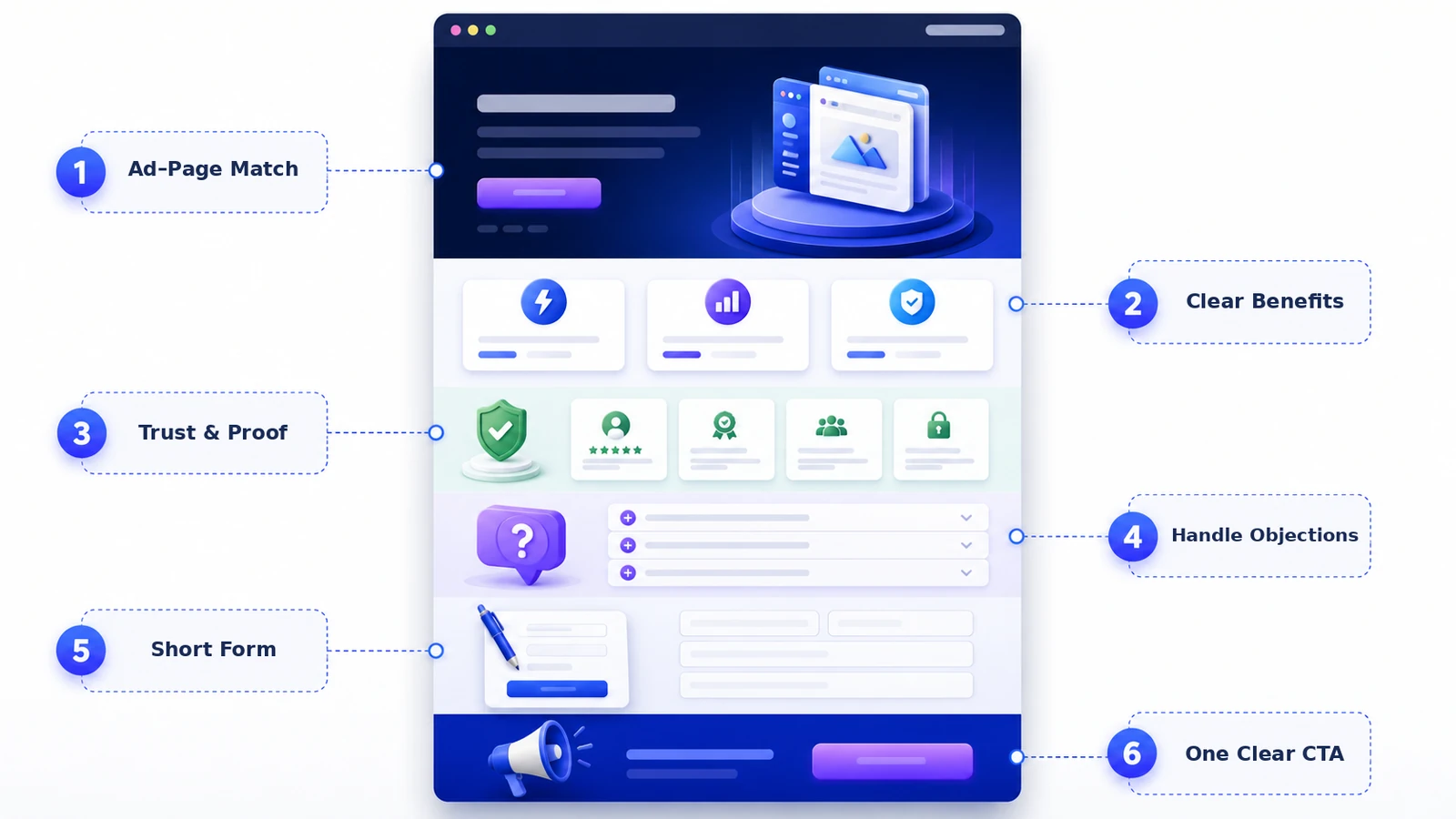
1. Above the Fold: Confirm, Explain, Act
The first screen should answer three questions within seconds:
- Am I in the right place?
- What do I get?
- What should I do next?
Include a specific headline, a concise value proposition, one primary CTA, and a relevant visual or product view. Add a compact trust signal if it is genuine: review rating, client count, certification, service area, response time, or recognizable customer.
2. Benefits Before the Corporate Biography
Translate features into business outcomes. “Automated reporting” is a feature. “Know which campaigns generated sales without combining five spreadsheets every Monday” is a benefit.
Use three to five benefits that directly answer the visitor’s intent. Avoid generic claims such as “innovative solutions,” “customer-centric excellence,” and their close relative, “we care.” Every competitor cares in the hero section.
3. Proof That Matches the Claim
Choose evidence according to the risk of the decision:
- customer reviews for local services;
- product ratings, returns information, and delivery details for e-commerce;
- case studies, named clients, integrations, security information, and implementation detail for B2B;
- before-and-after metrics with context for performance services.
“Trusted by 500 companies” is stronger when visitors can see who they are and why they trusted you. Never invent urgency, reviews, accreditations, or results. Fake trust signals are conversion sabotage wearing a nice badge.
4. Objections and Risk Reduction
List the reasons a qualified buyer might hesitate: price, time, complexity, contract length, migration risk, delivery, returns, data security, or internal approval. Address the important ones before the form.
Useful risk reducers include transparent conditions, a clear process, cancellation terms, guarantees you can honor, realistic timelines, and an FAQ. For B2B pages, explain what happens after the form is submitted. “We will contact you” is vague; “A specialist will review your request and respond within one business day” sets an expectation.
5. A CTA Proportionate to Buyer Readiness
A visitor searching “enterprise CRM comparison” may not be ready to “Buy now.” A visitor searching “book CRM demo” probably is. Match the action to the intent:
- early research: view comparison, calculate cost, download checklist;
- active evaluation: see pricing, request assessment, watch product tour;
- high intent: book demo, call now, request quote, start trial, purchase.
You can repeat the same primary CTA throughout a long page. That is still one goal. A secondary CTA is justified only when it supports a genuine alternative path, such as calling instead of completing a form—not when every department wants its own button.
Forms: Ask Only for Information You Will Actually Use
Every field creates friction, but fewer fields do not automatically mean better leads. A two-field form may generate more submissions and more conversations with people who cannot buy. Optimization should balance volume, qualification, and sales capacity.
For a simple local request, name, contact detail, service, and location may be enough. A high-value B2B inquiry might justify company, role, use case, size, and timeline. If qualification requires many questions, consider a multi-step form that begins with an easy, relevant choice and shows progress.
Good form practice:
- use visible labels rather than placeholder-only instructions;
- select the correct mobile keyboard for phone and email fields;
- explain why sensitive information is requested;
- show specific error messages without deleting completed fields;
- include a short privacy explanation near the submission button;
- test the confirmation page, notification email, CRM record, and follow-up process.
A conversion is not complete because Google Tag Manager fired. It is complete when the lead reaches the right person and receives an appropriate response.
Mobile Speed and Usability: Test the Real Experience
Responsive design is the starting point, not the finish line. Open the page on an average phone, use a slower connection, accept or reject the consent banner, complete the form, rotate the screen, and tap the phone number. This five-minute exercise has exposed more problems than many elegant desktop presentations.
Prioritize:
- compressed, correctly sized images;
- limited third-party scripts;
- stable layouts that do not jump while loading;
- readable type and sufficiently large tap targets;
- a visible CTA without a screen full of decorative content;
- forms that can be completed with one hand.
Google’s current Core Web Vitals focus on loading performance, responsiveness, and visual stability. They are useful technical guardrails, although a passing score does not prove that a page is persuasive. Review the definitions and recommended thresholds in the official Web Vitals guidance.
Navigation, SEO, and the “Noindex” Question
Many PPC landing page best-practice lists say “remove navigation.” Treat that as a testable principle, not a religious commandment. Removing the full menu often reduces distraction for a narrow campaign. However, users may still need access to privacy information, legal details, contact information, accessibility support, or deeper product documentation.
The same nuance applies to SEO. A temporary, campaign-specific page with duplicated or highly personalized copy may be set to noindex. An evergreen page that provides substantial value and targets a useful organic query may deserve indexing. Do not automatically block every PPC page. Decide based on duplication, longevity, search intent, and the quality of the content.
If one URL serves both SEO and PPC, be careful with experiments, dynamic text, removed navigation, and tracking parameters. Paid conversion gains should not quietly damage organic discoverability. Our article on SEO and conversion optimization explains how to improve revenue without treating search visibility and CRO as rival departments.
Conversion Tracking for the US and Europe
Before spending money, define the business outcome and verify the measurement path. Track the primary conversion—sale, qualified lead, booked appointment, or activated trial—rather than treating every button click as equally valuable.
At minimum, test:
- Google Ads conversion actions and GA4 events;
- form success only after valid submission;
- telephone and booking conversions where relevant;
- UTM and click identifiers through redirects and CRM handoff;
- duplicate events caused by reloads or thank-you pages;
- offline qualification and sales imports for longer B2B cycles.
European campaigns require additional care. Consent choices affect which tags may run and what can be measured. The EU’s data-protection framework establishes rules for processing personal data; use the European Commission’s GDPR resources as a starting point and obtain qualified legal advice for your specific implementation. Marketing articles are useful. They are not lawyers wearing cheaper shoes.
Also separate marketing performance from tracking completeness. A reported conversion may be missing because of consent or technical failure; a reported lead may be spam; an imported sale may arrive weeks later. Reconcile platform data with the CRM or order system.
The Metrics That Actually Diagnose a PPC Landing Page
Conversion rate is important, but it is not a complete verdict. Real landing page conversion rate optimization connects page behavior with lead quality and business economics:
| Metric | What It Tells You | Common Misread |
|---|---|---|
| Conversion rate | How often visitors complete the tracked action | A higher rate can still produce lower-quality leads |
| Cost per conversion | Traffic cost required for one tracked outcome | Not every tracked conversion has equal business value |
| Qualified lead rate | How many leads match sales criteria | Usually invisible inside the ad platform without CRM data |
| Customer acquisition cost | Total acquisition cost per new customer | Ignoring agency, creative, software, or sales costs |
| Revenue or profit per click | Economic value generated by paid visits | Revenue can hide poor margins |
| Form completion rate | Friction between starting and submitting | Does not reveal whether the right people started |
| Speed by device | Technical experience for mobile and desktop users | Lab tests may differ from real-user conditions |
Segment results by campaign, ad group, keyword or search term, device, location, and new versus returning visitor. An average can hide a brilliant desktop page and a disastrous mobile form living under the same URL.
PPC Landing Page Optimization: A Testing Process That Does Not Lie to You
A/B testing sounds scientific, but low-volume tests often produce decorative statistics rather than decisions. Before testing, write a hypothesis:
Because [evidence], changing [element] for [audience] should improve [primary metric] without reducing [quality guardrail].
Example: “Because mobile visitors abandon the six-field form, splitting it into two steps should increase completed quote requests without lowering the qualified-lead rate.”
Prioritize Tests by Evidence and Impact
- Fix broken tracking, forms, layout, and slow loading first. Bugs do not need A/B tests.
- Test high-impact propositions: offer, audience-message match, price framing, or CTA.
- Then test structure, proof, objection handling, and form design.
- Test cosmetic details only when there is a credible reason.
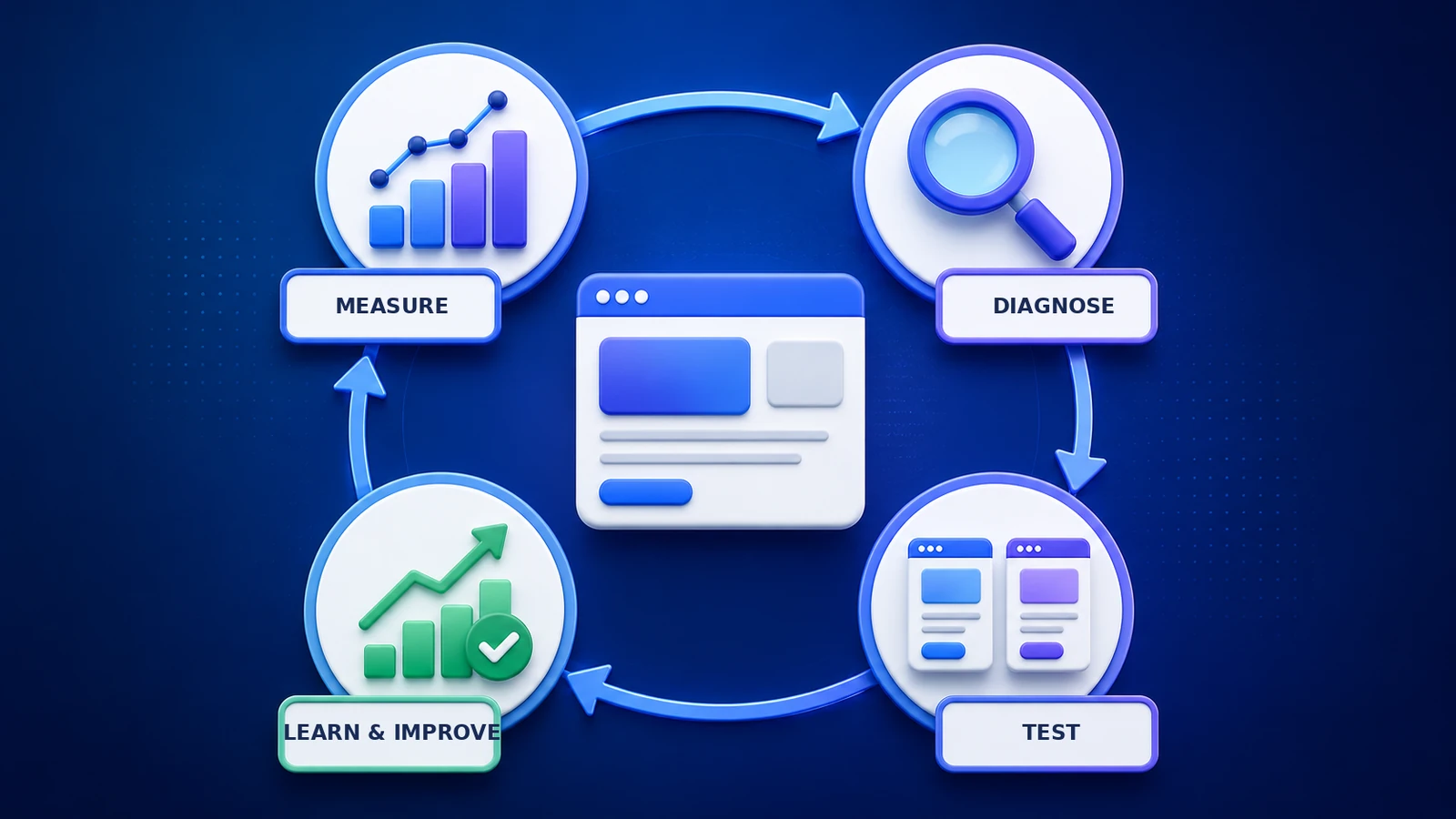
Run the test long enough to cover normal business cycles and gather adequate conversions. Avoid stopping the moment one version takes an early lead. If traffic is too low for a reliable split test, use qualitative evidence—sales interviews, form errors, session recordings with appropriate consent, usability testing—and make a reasoned change. Waiting six months to learn whether a green button beat a blue one is not disciplined optimization. It is interior decorating with a spreadsheet.
Three Practical PPC Landing Page Examples
Local Service: Emergency Plumbing
Ad intent: urgent help in a defined area. Page: city and service in the headline, current availability, click-to-call button, service-area confirmation, credible reviews, expected response process, and a short backup form. Do not begin with the founder’s childhood fascination with pipes.
B2B SaaS: Product Demo
Ad intent: evaluate a solution. Page: role-specific outcome, product interface, integrations, relevant customer story, implementation expectations, security or compliance information, and a demo form that collects only useful qualification data. Send the booking to the correct sales calendar and pass campaign context into the CRM.
E-Commerce: High-Intent Product Campaign
Ad intent: buy or compare a specific product category. Page: exact category or product promised, transparent price, delivery and returns information, reviews, useful filters, clear stock status, and a fast checkout path. For broader campaign strategy, see our guide to Google Ads for e-commerce.
Common Landing Page Mistakes That Waste Paid Traffic
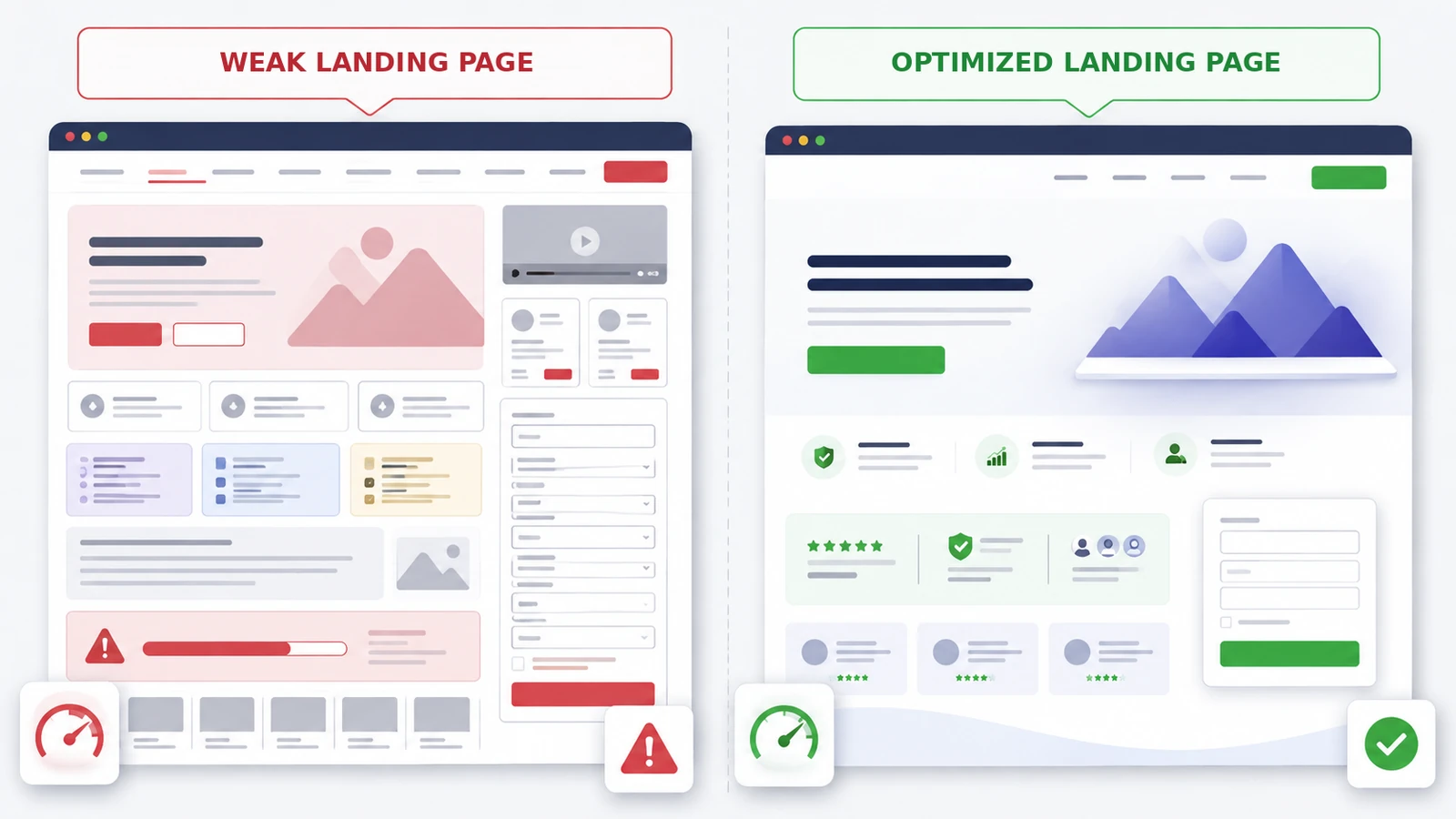
- One page for every campaign: unrelated intents receive generic messaging.
- A page for every keyword: the account becomes impossible to maintain and fills with near-duplicates.
- Ad and page offer mismatch: discounts, prices, deadlines, or product details change after the click.
- Too many choices: menus, pop-ups, chat prompts, and competing CTAs interrupt the primary journey.
- Weak proof: claims are broad while evidence is anonymous or irrelevant.
- Premature forms: the page asks for personal data before earning enough trust.
- Desktop-only approval: nobody tests the page on the device most customers use.
- Tracking button clicks as leads: dashboards celebrate actions that never reached sales.
- Testing without volume: random movement is presented as a winning variation.
- Ignoring follow-up: expensive leads wait two days for a response.
PPC Landing Page Launch Checklist
- The page serves one defined audience and intent.
- The headline continues the ad’s promise.
- The offer and conditions match the advertisement.
- One primary conversion goal is obvious.
- Benefits are specific and supported by relevant proof.
- Major objections are answered before the final CTA.
- The form asks only for information the business will use.
- The mobile page, consent flow, form, call link, and confirmation work.
- Primary conversions are verified in Google Ads, analytics, and the CRM.
- Page speed and Core Web Vitals have been checked.
- Privacy and legal links are accessible.
- A follow-up owner and response-time expectation are defined.
- Baseline metrics and the first optimization hypothesis are documented.
Ready to Grow With PPC Instead of Burning Budget?
Whether you are launching your first campaign or repairing one that keeps consuming budget, we will tell you what works, what does not, and what the next step should be. Free and without obligation.
