
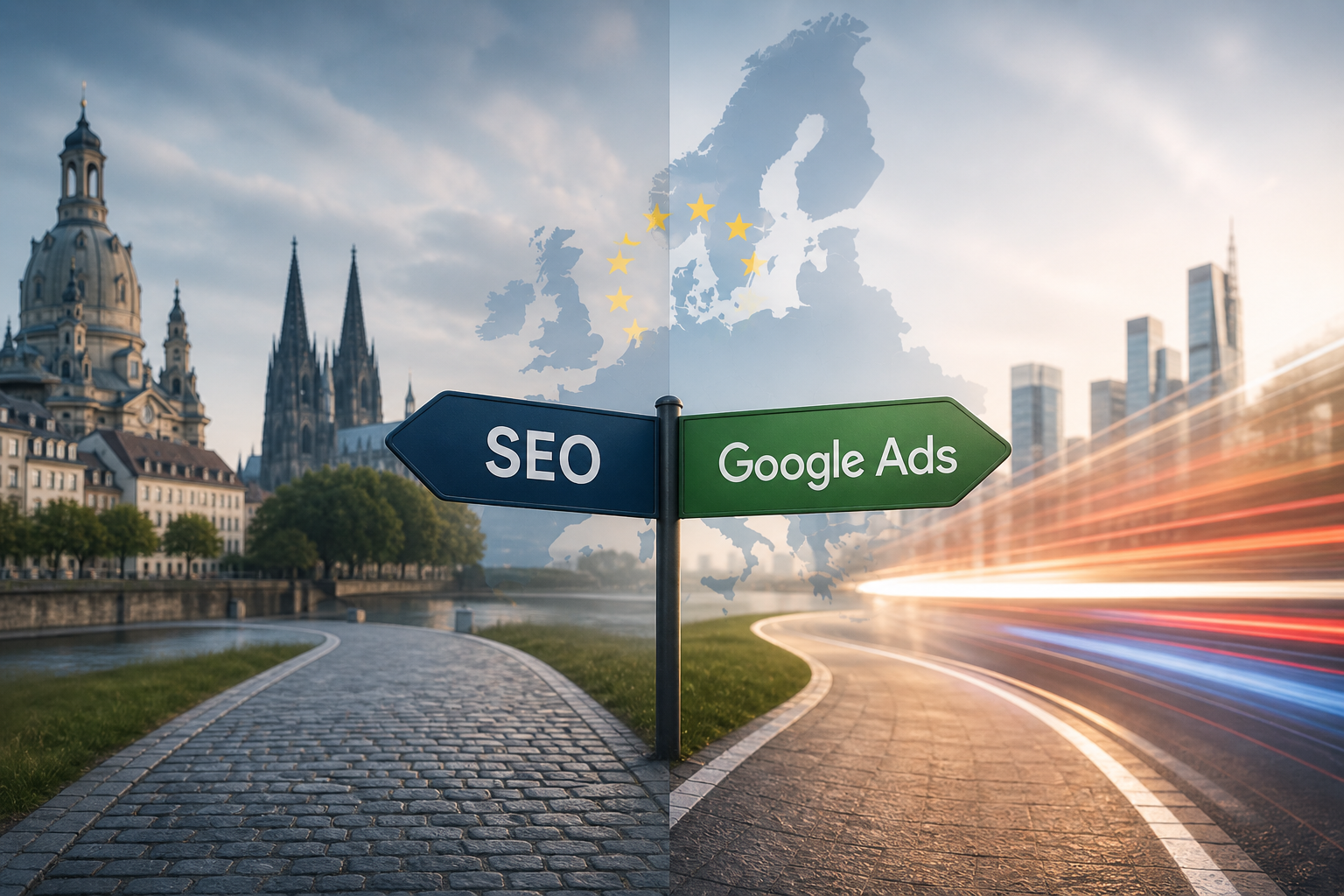
You’ve read a dozen comparisons of SEO vs Google Ads. They all say the same thing: “SEO is a long game, Ads give quick results, ideally use both.” Useful? Sure. But here’s the problem — most of that advice was written with the US market in mind.
Europe is different. The rules, the tools, the user behavior, and even the legal framework — all of it shapes how organic search and paid advertising actually perform here. If you’re running a business in Germany, Austria, Switzerland, or anywhere else in the EU, some of what you’ve read simply doesn’t apply.
The Core Difference Nobody Talks About: GDPR
Before we even compare Google Ads vs SEO, we need to talk about the elephant in the room — GDPR and its downstream effects on tracking.
In the US, you can drop cookies freely, fire conversion tags on every page, and build remarketing lists without friction. In Europe? Not so fast. Cookie consent banners are legally required, and — crucially — a large share of users click “Decline.”
What does that mean in practice?
- Google Ads: Your conversion data becomes incomplete. If a user declines consent, their conversion doesn’t get tracked by default. This breaks Smart Bidding, because it trains on incomplete signals. Your cost per click stays the same; your attribution gets worse.
- SEO / Organic Search: Organic traffic doesn’t depend on cookies to exist. The visitor still arrives, the page still ranks. Your analytics might be gappy, but the organic traffic itself isn’t consent-dependent.
This one factor shifts the SEO vs Google Ads equation significantly in Europe. Paid advertising still works — absolutely. But it requires extra infrastructure (Consent Mode v2, server-side tagging, first-party data strategy) that most US-focused guides ignore.
How the German Market Specifically Behaves
Germany has one of the highest ad-blocker usage rates in Europe — around 35–40% of desktop users run an ad blocker. That’s not a niche behavior; it’s mainstream.
Educated, privacy-conscious German users have been blocking paid advertising for years.
- For Google Ads: A significant share of your potential audience literally won’t see your ads. Combined with consent-based data loss, your effective reach in Germany is narrower than your budget suggests.
- For SEO / Organic Search: Organic results aren’t blocked. A user with an ad blocker and a “Decline All” habit still sees your organic listing and clicks it. Search engine optimization has a structural advantage in the German market that doesn’t exist to the same degree elsewhere.
Google Ads vs SEO: Speed, Cost, and Conversion Rates
Time to First Results
Google Ads — launch today, get clicks tomorrow. If you need leads this quarter, paid search is the lever to pull. Short-term visibility is where paid advertising wins, full stop.
SEO — three to six months before you see meaningful movement in organic search results. In competitive German industries — legal, finance, B2B software — it can take longer. Link acquisition in the DACH market is genuinely harder than in English-language SEO.
 If you’re entering a new European market cold, you need Google Ads to cover the gap while SEO builds. Expecting organic growth in month two is a fantasy.
Cost Per Click vs Long-Term SEO Investment
Google Ads — you pay for every click, every day. In Germany, average cost per click in B2B industries runs €3–15+. Stop paying, stop appearing.
SEO — upfront investment in content creation and technical work, then compounding returns. A well-ranking article doesn’t invoice you per click. Over a 24-month horizon, the cost of organic traffic drops significantly compared to paid search.
German-language content creation is expensive if you’re not native. Machine translation won’t cut it — German users (and Google) notice unnatural phrasing immediately. Factor real translation and editing costs into your SEO strategy from day one.
Conversion Rates: Organic Search vs Paid Advertising
Across most industries, organic search visitors convert at roughly double the rate of paid search visitors. The reason is intent alignment — someone who found you through organic SEO after a genuine search tends to be further along in their decision-making than someone who clicked a paid ad.
This matters especially in B2B, where sales cycles are long and trust is earned slowly. A German Mittelstand buyer who found your content through organic search and read three articles before reaching out is a different kind of lead than someone who clicked a banner.
Google Ads vs SEO for German SMEs
This is where the comparison gets really interesting — and where generic guides fall short.
- Budget constraints. Most German SMEs can’t sustain large paid advertising budgets indefinitely. SEO becomes increasingly cost-effective over time — which matters when you can’t compete on budget with larger players in paid search.
- Long buying cycles. B2B decisions in Germany take time. Organic content — guides, comparisons, use cases — supports this cycle far better than a paid ad that disappears after one click. A landing page can convert; a blog article builds trust over multiple visits.
- Trust signals matter more here. German buyers are traditionally skeptical of advertising. Appearing organically in search results carries more implicit credibility than a paid placement. This cultural factor amplifies the conversion rate gap between SEO and Google Ads.
- Local search intent. Many German SMEs rely on regional customers. Local SEO is often dramatically underutilized — and significantly less competitive than national paid search campaigns.
Verdict for German SMEs: Start with Google Ads to generate immediate leads, but invest in SEO as early as possible. The compounding effect of organic traffic is your long-term competitive advantage.
Where Google Ads Still Wins in Europe
There are clear situations where paid search is the correct tool — even in the European context.
- New market entry. Zero organic presence means zero organic leads. Google Ads bridges the gap. Non-negotiable.
- Seasonal or promotional campaigns. Product launches, events, limited-time offers — immediate visibility is the only option. SEO can’t be switched on for three weeks.
- Testing what converts. Google Ads gives you fast feedback on which messages, landing pages, and offers actually resonate. That data directly improves your SEO content strategy. Think of it as paid research.
- Highly specific B2B intent. For niche, high-value queries with low search volume, pay per click can capture intent cost-effectively without requiring a full content creation operation.
The Right Frame: Sequencing and Budget Allocation
The real question isn’t “SEO vs PPC?” — it’s about sequencing and budget allocation across your growth stage.
- Stage 1 — New market: 70–80% to Google Ads (paid search now), 20–30% to SEO foundations. Expect 6–9 months before organic search contributes meaningfully.
- Stage 2 — Established presence: Rebalance to 50/50. Organic traffic returns leads at lower cost per click. Ads budget shifts toward retargeting and new audiences.
- Stage 3 — Market leader: SEO drives organic growth. Paid advertising focuses on high-value competitive terms and brand defense.
Don’t forget Bing. In Germany, Bing holds around 5–8% market share — small, but B2B skews toward corporate Microsoft users. Microsoft Ads CPCs are frequently cheaper than Google. Worth adding to the paid search mix.
Practical Checklist: Launching in Germany
For Google Ads in the EU:
- Consent Mode v2 implemented (Google’s requirement + GDPR compliance)
- Server-side tagging or enhanced conversions set up to recover lost signal
- Separate campaigns for Germany, Austria,
- Switzerland — CPCs and behavior differ
- Ad copy and landing page reviewed by a native German speaker
For SEO / Organic Search in Germany:
- Hreflang correctly implemented for multi-language/multi-region content
- .de domain or country-targeting set in Google Search Console
- Content creation done by native German writers, not machine-translated
- Local link acquisition strategy — German directories, industry publications, partnerships
The Bottom Line: SEO vs Google Ads in Europe
SEO and Google Ads aren’t competing channels — they’re complementary tools that serve different phases of your business and different moments in a buyer’s journey.
In Europe, the calculus is different. GDPR limits your tracking and Smart Bidding efficiency. High ad-blocker rates in Germany reduce your effective paid advertising reach. German-language search engine optimization takes longer and costs more to do well. All of this means the case for building strong organic search visibility is, if anything, stronger here than in the US.
The businesses that win in European markets invest in both channels intelligently — using Google Ads to generate revenue today, and SEO to reduce cost per click and cost of acquisition over time.
If you’re not sure which mix makes sense for your stage and market, that’s exactly the kind of question worth discussing before committing budget in either direction.
