



How to Choose a Digital Marketing Agency: A Practical Selection Guide
Choosing a digital marketing agency is difficult for a simple reason: you usually have to judge the quality of the work before the work exists. Every shortlist contains polished websites, confident sales calls, impressive logos and promises of growth. Those signals can be useful, but none of them proves that an agency can understand your economics, execute consistently and improve results over time.
The safest way to choose is to replace impressions with evidence. Define what you need, compare agencies against the same criteria, test the thinking behind their proposals and make the commercial terms as clear as the strategy. This guide gives you a practical process for doing exactly that.
What to Know Before Choosing a Digital Marketing Agency
Do not start by searching for “the best agency.” Start by defining the problem. A strong agency may help refine your strategy, but it cannot compensate for unclear priorities, an unproven offer or an internal team that cannot approve work.
Write a one-page brief before contacting anyone. Include your business model, target market, main products or services, current channels, approximate budget, internal resources and the business outcome you want. Replace goals such as “more visibility” with measurable outcomes: qualified leads, ecommerce revenue, customer acquisition cost, demo bookings or growth in non-brand organic demand.
Also establish a baseline. Record current spend, lead volume, revenue, conversion rate and sales quality. Without a baseline, neither you nor the agency can distinguish genuine improvement from normal fluctuation.
Which Type of Marketing Agency Do You Need?
One of the most common mistakes when hiring a marketing agency is buying a broad package before identifying the actual bottleneck. The main types of agencies in marketing include:
- Full-service agencies: coordinate several channels, such as SEO, paid media, content, social and creative.
- Specialist agencies: focus deeply on one discipline, such as technical SEO, Google Ads, email or conversion optimization.
- Industry specialists: understand the buying cycle, regulations and economics of a specific sector.
- Strategy consultancies: diagnose priorities and design a roadmap, while execution stays in-house or with other suppliers.
- Freelancers and small teams: often provide direct access to experienced practitioners and work well with a narrow scope.
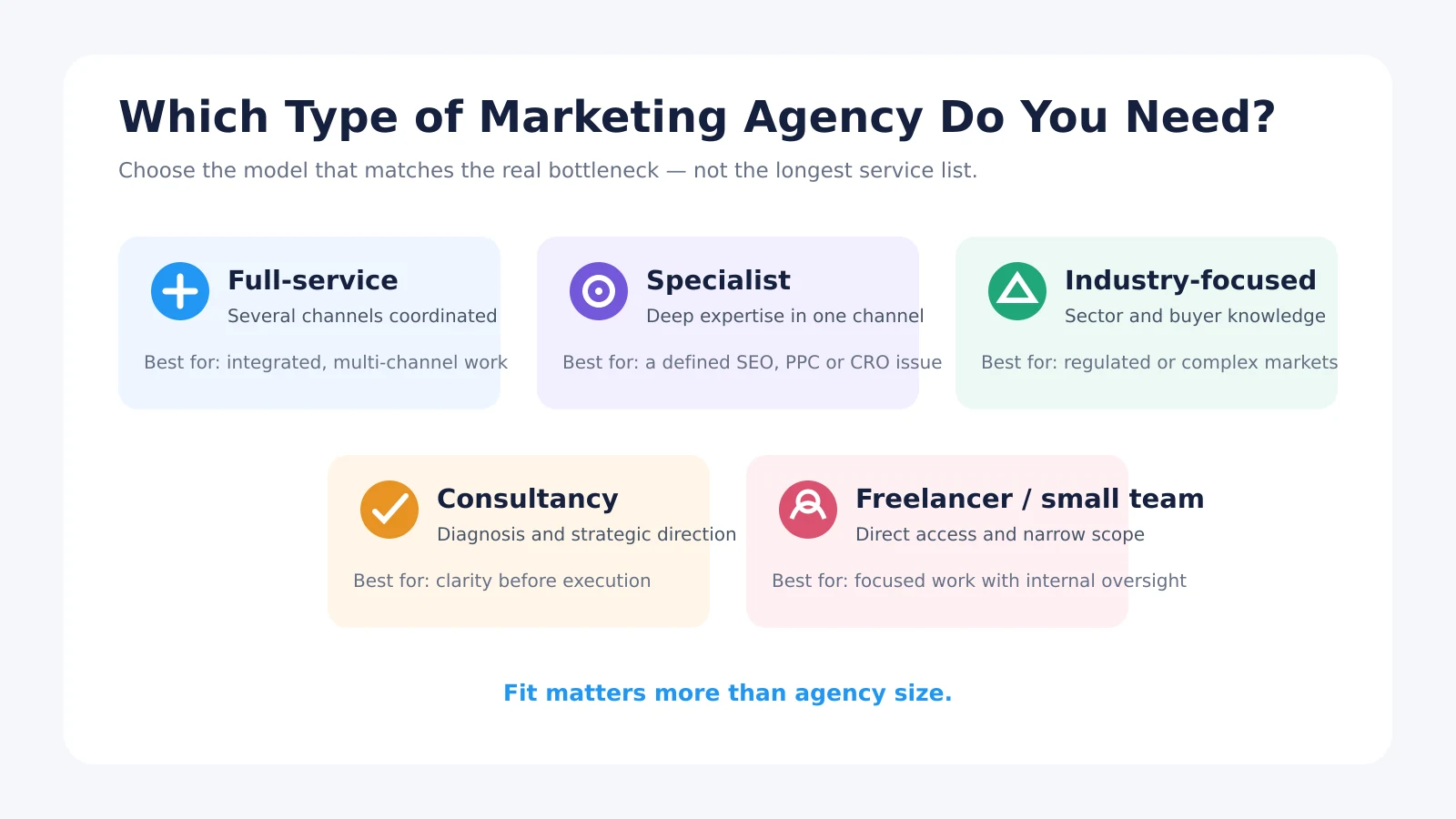
Choose based on the complexity of the problem, not the size of the provider. A specialist may be the better choice for a technical organic-growth problem; a coordinated team may be more suitable when paid acquisition, landing pages, analytics and content must work together. If you are deciding between organic and paid acquisition, our guide to SEO versus Google Ads explains the trade-offs.
How to Choose a Digital Marketing Agency in Seven Steps
1. Translate business goals into agency requirements
Work backward from the outcome. If your objective is qualified B2B leads, you may need search demand analysis, paid search, landing pages, conversion tracking and CRM feedback—not generic social media posting. If organic visibility is falling, begin with diagnosis rather than committing immediately to twelve months of content production.
Separate must-haves from optional capabilities. This prevents an attractive but irrelevant service list from influencing the decision.
2. Build a shortlist of three to five agencies
Use recommendations, relevant search results, industry communities and credible review platforms. Clutch can help identify candidates, but reviews should be treated as one evidence source rather than proof on their own.
Review the agency’s own marketing. It does not need to rank first for every competitive term, but its positioning, content and conversion path should demonstrate competent judgment. Exclude providers whose expertise, team or service ownership remains unclear.
3. Evaluate relevant expertise, not logo prestige
A famous client logo may represent a small subcontracted task completed years ago. Ask what the agency actually did, who did it and what changed. The strongest evidence is a case study with a credible baseline, actions, timeframe and business outcome.
Exact industry experience is helpful when regulation or specialist knowledge matters, but it is not always essential. Channel expertise, a comparable sales cycle and the ability to learn your market may matter more. Ask candidates to explain how your business model changes their recommended approach.
4. Assess the diagnosis before the proposed tactics
A good proposal should connect observed problems to recommended actions. Be cautious when an agency prescribes a fixed number of blog posts, backlinks or campaigns before examining your data. Strategy is a sequence of choices: what to prioritize, what to postpone, why it matters and how the team will know whether it worked.
Ask what the agency would investigate during the first 30 days and which finding could change its plan. An honest answer shows that the proposal contains hypotheses, not manufactured certainty.
From our experience: A technical problem can easily be mistaken for a content or authority problem. While working on a B2B SaaS website built on an unsupported legacy CMS, we found multiple accessible copies of the site and unusually high crawler activity around JavaScript and page resources. Instead of immediately recommending more content, we tested the technical hypothesis on a separate lightweight website and used the findings to support a full migration. The lesson is simple: ask an agency how it distinguishes the underlying constraint from its symptoms.
5. Verify measurement and data ownership
Reporting should connect channel metrics to commercial outcomes. Rankings, clicks and impressions are diagnostic indicators; leads, revenue, acquisition cost and pipeline quality are business indicators. The right combination depends on your sales cycle.
Confirm that your company will own or retain administrator access to:
- Google Ads and other advertising accounts;
- GA4, Google Tag Manager and Search Console;
- dashboards, pixels, audiences and conversion definitions;
- creative files, landing pages and approved content;
- documentation and historical campaign data.
Google’s official manager-account documentation explains how account access and ownership work. Never accept a setup that makes leaving the agency equivalent to losing your history.
A tracking example: We have seen ecommerce campaigns evaluated with incomplete Google Tag Manager data: product IDs, transaction values and key events were missing. Until the tracking was repaired, neither the client nor the marketer could assess performance reliably. This is why tracking validation should happen before an agency begins optimizing campaigns.
6. Meet the people who will actually do the work
The sales team may disappear after the contract is signed. Ask to meet the strategist or account lead who will work on your business. Clarify how much senior attention you receive, which tasks are outsourced, how quality is reviewed and who covers absence.
Good communication is not constant communication. It means clear responsibilities, decisions recorded in writing, predictable response times and meetings that end with actions. Agree on reporting cadence and approval deadlines before work starts.
7. Compare proposals using the same scorecard
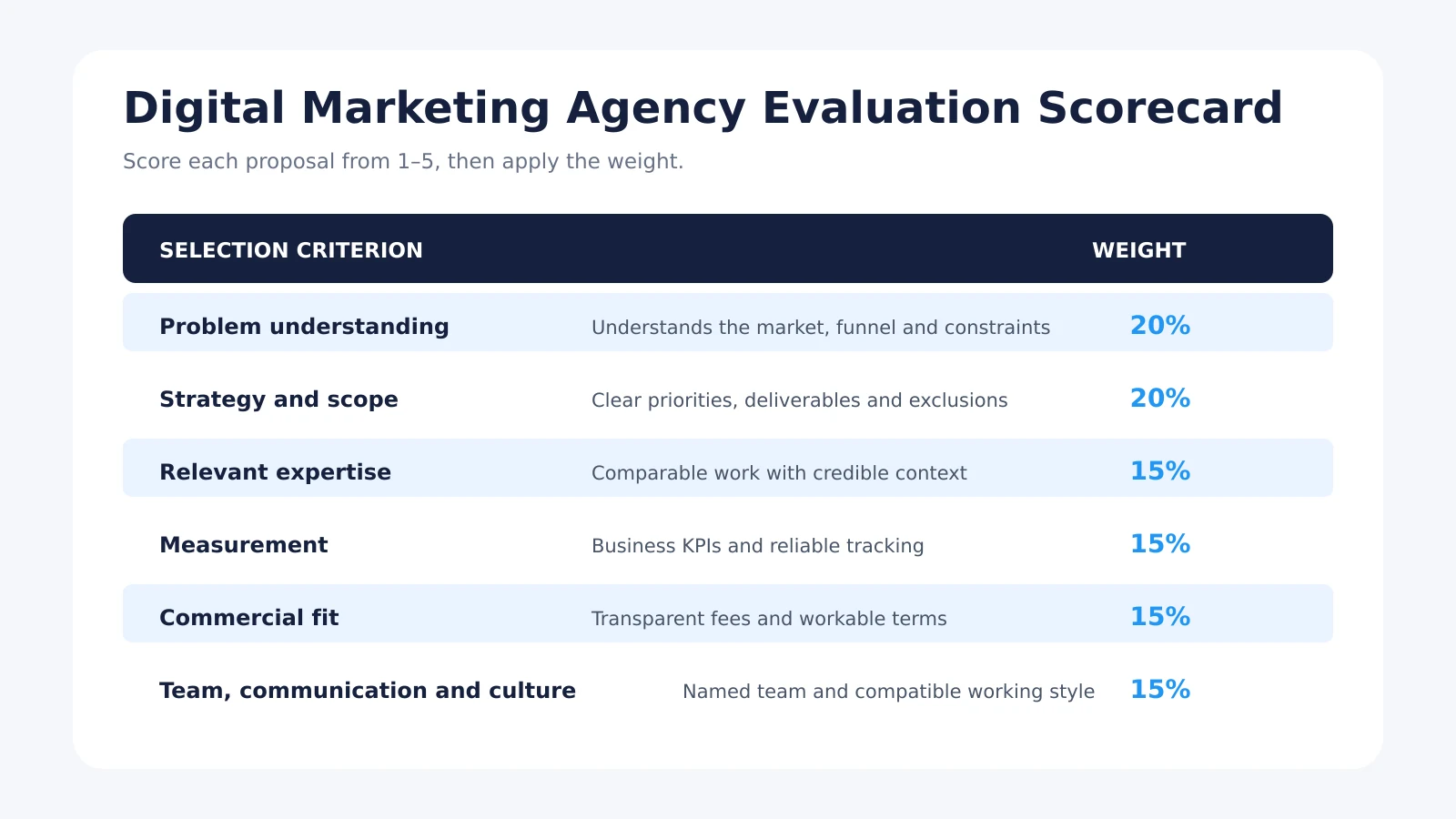
Do not compare only monthly fees. Score each proposal from one to five across the following criteria, then weight the criteria that matter most to your business.
| Criterion | What strong evidence looks like | Suggested weight |
|---|---|---|
| Problem understanding | Connects your market, funnel and constraints to priorities | 20% |
| Relevant expertise | Comparable work with verifiable context and outcomes | 15% |
| Strategy and scope | Clear deliverables, dependencies, exclusions and sequence | 20% |
| Measurement | Business KPIs, reliable tracking and decision rules | 15% |
| Team and communication | Named delivery team, cadence and responsibilities | 15% |
| Commercial fit | Transparent fees, flexibility and realistic terms | 15% |
| Cultural fit | Direct communication and compatible working style | 5% |
A scorecard will not make the decision for you, but it prevents a charismatic presentation or low price from overpowering more important evidence.
Need SEO, Google Ads—or a clearer priority?
Review how Klucco approaches measurable search growth before you compare agency proposals.
Questions to Ask a Marketing Agency Before Hiring
The quality of an agency’s answers matters more than the confidence with which they are delivered. Ask every shortlisted provider the same core questions:
- What do you need to learn before recommending a strategy? Strong agencies ask about margin, sales quality, capacity, seasonality and prior tests.
- What would you prioritize in the first 90 days, and why? Look for sequencing and trade-offs rather than a long activity list.
- Which assumptions in your proposal still need validation? Marketing contains uncertainty; credible partners name it.
- Which business KPIs will guide decisions? Ask how platform metrics connect to sales outcomes.
- Who will work on our account, and how much time is allocated? Request roles and responsibilities, not vague access to “the team.”
- What is included, excluded and billed separately? Clarify media spend, tools, creative production, development and meetings.
- What do you need from our team? Results often depend on access, approvals, sales feedback and subject-matter expertise.
- How do you respond when a channel underperforms? Look for a diagnostic process, not excuses or instant promises.
- Can we speak to a relevant current or former client? Ask that reference about delivery, transparency and problem handling.
- What happens when the relationship ends? Confirm notice periods, handover, account access and ownership.
For a more specific example of how a competent provider should approach paid media, use our Google Ads audit checklist as a reference during interviews.
How to Read an Agency Proposal
A useful proposal should define objectives, scope, deliverables, responsibilities, timing, measurement and fees. Watch for ambiguous verbs such as “optimize,” “support” or “manage” without an explanation of what work they include.
Separate management fees from ad spend and third-party costs. Identify whether copy, design, development, tracking implementation and reporting are included. Ask what happens when additional work is discovered. The cheapest proposal may simply exclude the work required to produce the result.
Pricing models include monthly retainers, fixed projects, hourly work, performance components and hybrids. None is inherently best. A retainer suits ongoing optimization; a fixed scope fits a defined audit or migration. Performance pricing requires unusually precise attribution rules and can encourage the wrong behavior if incentives are poorly designed.
Red Flags When Hiring a Marketing Agency
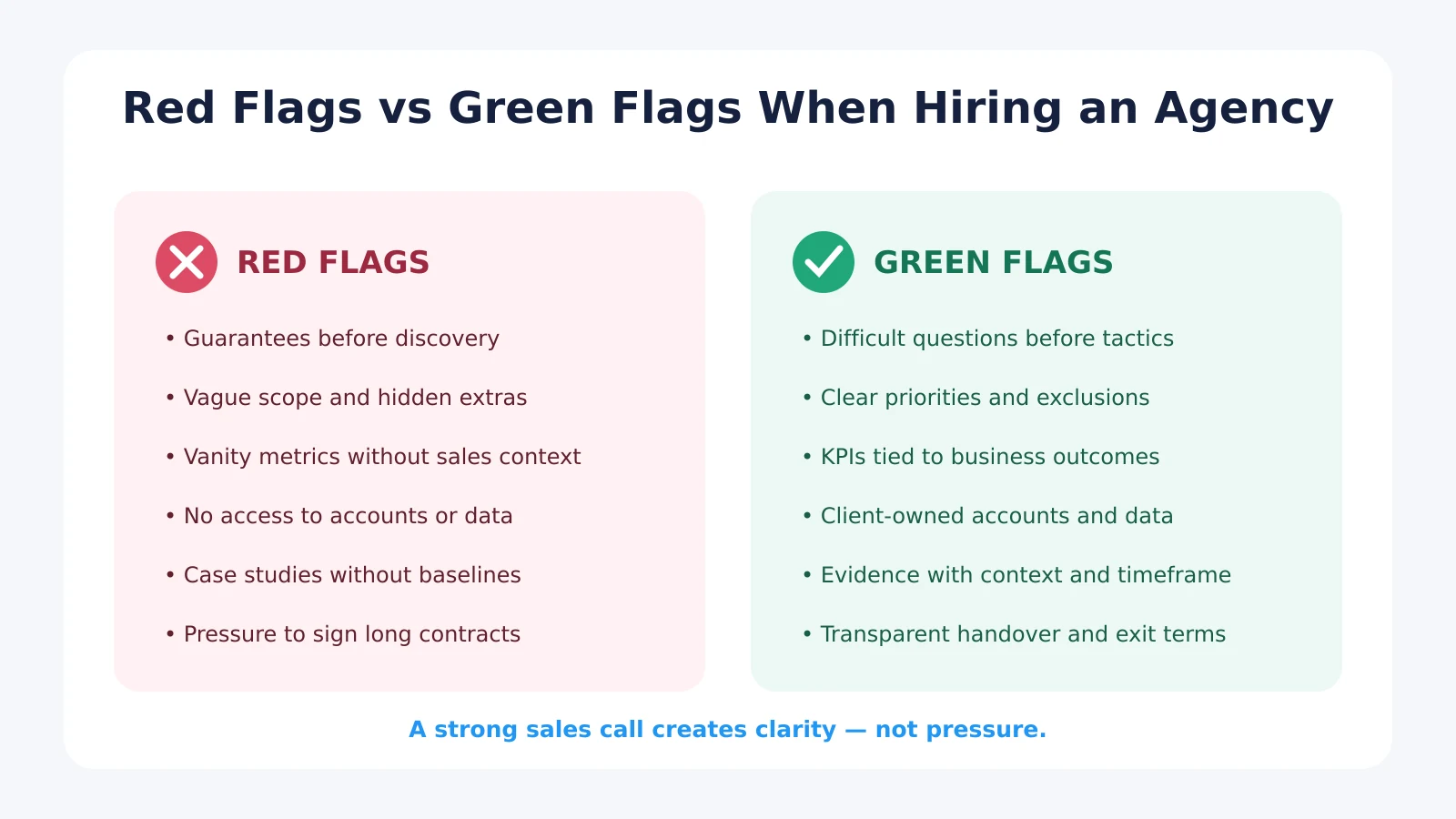
- Guaranteed rankings, revenue or immediate results without conditions.
- A strategy proposed before meaningful discovery.
- Case studies with percentages but no baseline, timeframe or scope.
- Reporting built around vanity metrics while lead quality is ignored.
- Refusal to provide account access or explain methods.
- Pressure to sign a long contract before scope and team are clear.
- Unclear outsourcing or frequent hand-offs between account managers.
- A large service catalogue with no demonstrated depth in your priority channel.
Google explicitly warns that nobody can guarantee a number-one organic ranking. Its guide to hiring an SEO is also useful when evaluating broader digital agencies.
Green Flags of the Right Marketing Agency
A good candidate makes the problem clearer during the sales process. It asks difficult questions, distinguishes facts from assumptions, explains trade-offs and is willing to say that a channel may not be your first priority. Its case studies are specific, its scope is readable and its team can explain the work without hiding behind jargon.
The right marketing agency also protects your interests: you retain access to data, understand what is being tested, know how success is evaluated and can leave with usable documentation. Cultural fit matters, but professional disagreement is often healthier than constant agreement.
Should You Hire an Agency, Freelancer or In-House Marketer?
Hire a freelancer when the task is narrow and you can manage the work internally. Build in-house when marketing is a core capability requiring daily context and close collaboration. Choose an agency when you need several specialist skills, flexible capacity or a faster route to an established process.
A hybrid model is common: an internal marketing owner sets priorities and shares business context while specialists handle SEO, paid media or analytics. Whatever the model, assign one person inside your company to own approvals and connect marketing data with sales feedback.
Final Checklist for Choosing the Right Marketing Agency
- Our goal, baseline, budget and internal constraints are documented.
- The agency type matches the real bottleneck.
- Relevant case studies include context, timeframe and outcomes.
- The proposed strategy explains priorities and trade-offs.
- Scope, exclusions and additional costs are explicit.
- The delivery team and communication cadence are known.
- KPIs connect marketing activity to business outcomes.
- Our company retains ownership and access to accounts and data.
- Contract, notice period and handover requirements are acceptable.
- References and claims have been verified independently.
Looking for a marketing partner who starts with the problem?
Tell us what you want to improve. We will give you a direct assessment of the priorities, realistic expectations and the next sensible step—without pressure.
